
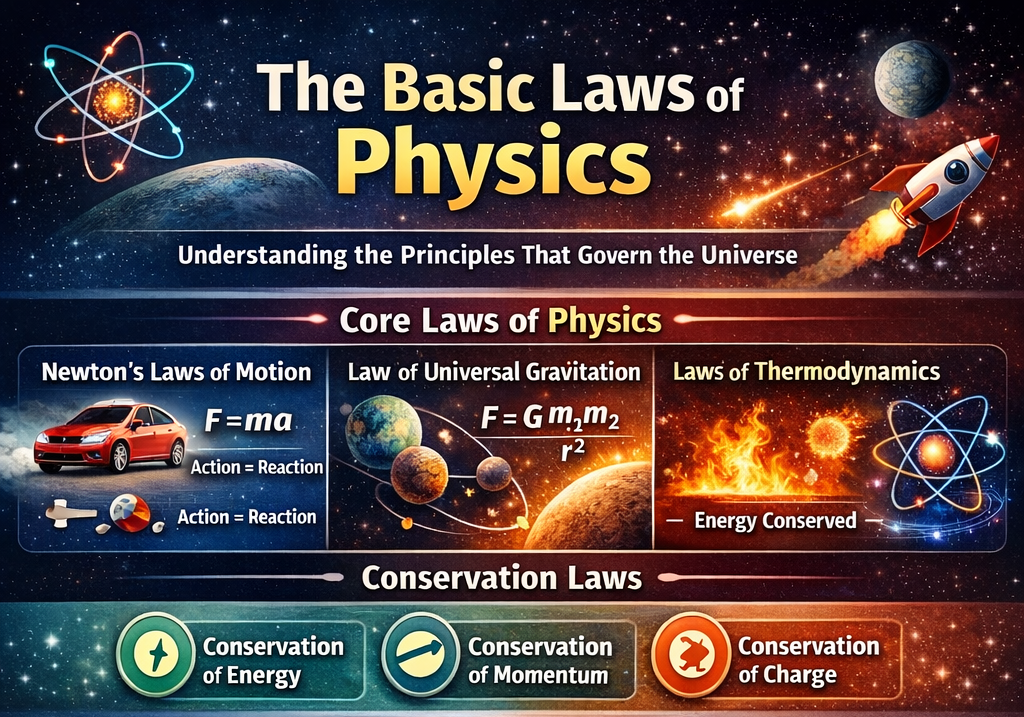
Physics is the foundation of science that helps us understand how the universe works. From the motion of everyday objects to the behavior of light and energy, physics explains everything around us. At the core of this subject are the basic laws of physics, which are universal rules that describe how nature behaves.
These laws are not limited to Earth—they apply throughout the entire universe. Whether it’s a falling apple, a moving car, or a distant planet orbiting a star, all follow the same fundamental principles. In this article, we will explore these laws in a simple and easy-to-understand way.
What Are the Basic Laws of Physics?
The basic laws of physics are principles that explain the relationship between matter, energy, force, and motion. Scientists discovered these laws through observation, experimentation, and mathematical analysis.
These laws help us:
- Understand natural phenomena
- Predict outcomes of physical events
- Develop new technologies
- Solve real-world problems
They form the backbone of modern science and engineering.
Newton’s Laws of Motion
Newton’s laws of motion describe how objects move when forces act upon them. These laws are fundamental to classical mechanics.
First Law: Law of Inertia
This law states that an object will remain at rest or continue moving in a straight line at a constant speed unless acted upon by an external force.
In simple terms, objects resist changes in their motion. For example, a ball will not start moving unless you kick it, and once it is moving, it will not stop unless friction or another force slows it down.
Second Law: Force and Acceleration
F=maF = ma
This law explains that force is equal to mass multiplied by acceleration. It means that heavier objects require more force to move, while lighter objects can be moved more easily.
For example, pushing a bicycle is much easier than pushing a car because the car has more mass.
Third Law: Action and Reaction
For every action, there is an equal and opposite reaction. This law explains many everyday phenomena.
For instance, when you jump off the ground, your feet push down on the ground, and the ground pushes you upward with equal force.
Law of Universal Gravitation
Gravity is the force that pulls objects toward each other. The law of universal gravitation explains how this force works.
F=Gm1m2r2F = G \frac{m_1 m_2}{r^2}
According to this law, every object in the universe attracts every other object. The strength of this attraction depends on the mass of the objects and the distance between them.
This law explains:
- Why objects fall to the ground
- Why the Moon orbits the Earth
- Why planets revolve around the Sun
Laws of Thermodynamics
Thermodynamics deals with heat, energy, and how energy moves from one system to another.
First Law of Thermodynamics
This law states that energy cannot be created or destroyed. It can only change from one form to another.
For example, electrical energy can be converted into light and heat in a bulb.
Second Law of Thermodynamics
Heat always flows from a hotter object to a cooler one. This process happens naturally and cannot be reversed without external work.
This is why hot tea cools down over time.
Third Law of Thermodynamics
As temperature approaches absolute zero, the motion of particles slows down significantly. Absolute zero is the lowest possible temperature.
Electromagnetism
Electromagnetism explains the relationship between electricity and magnetism. It is one of the most important areas of physics because it powers modern technology.
These laws explain:
- How electric currents create magnetic fields
- How magnetic fields can generate electricity
- How light travels as an electromagnetic wave
Devices such as televisions, radios, and smartphones all rely on electromagnetic principles.
Conservation Laws
Conservation laws are essential principles in physics that state certain quantities remain constant in a closed system.
Conservation of Energy
Energy cannot be created or destroyed, only transformed from one form to another.
Conservation of Momentum
The total momentum of a system remains constant unless an external force acts on it.
Conservation of Charge
Electric charge cannot be created or destroyed. The total charge in a system remains constant.
These laws are widely used in solving physics problems and understanding natural processes.
Theory of Relativity
The theory of relativity changed the way scientists understand space, time, and energy.
Special Relativity
This theory explains how objects behave at very high speeds. It shows that time and space are not fixed but depend on the observer’s motion.
Famous Equation
E=mc2E = mc^2
This equation shows that mass can be converted into energy. It is the basis of nuclear energy and explains how stars produce light and heat.
General Relativity
This theory explains gravity as the bending of space and time caused by massive objects. It provides a deeper understanding of how planets and galaxies behave.
Quantum Mechanics
Quantum mechanics studies the behavior of very small particles such as atoms and electrons.
This field introduces concepts that are very different from classical physics:
- Particles can act like waves
- Energy exists in small packets called quanta
- It is impossible to know both the position and speed of a particle exactly at the same time
Quantum mechanics is the foundation of modern technologies like lasers, semiconductors, and quantum computing.
Importance of the Basic Laws of Physics
The basic laws of physics are important because they help us understand and control the world around us. Without these laws, modern life would not be possible.
They allow us to:
- Build machines and structures
- Develop advanced technologies
- Explore space
- Understand natural disasters
- Improve healthcare systems
Physics is not just a subject—it is a tool that shapes our future.
Real-Life Applications
The laws of physics are used in many areas of daily life:
- Transportation: Vehicles rely on motion and force
- Energy: Power plants use thermodynamics
- Electronics: Devices depend on electromagnetism
- Medicine: Imaging technologies use physics principles
- Engineering: Construction relies on physical laws
Every modern convenience is connected to physics in some way.
Conclusion
The basic laws of physics are the rules that govern the universe. They explain how objects move, how energy flows, and how forces interact. From simple daily activities to complex scientific discoveries, these laws are always at work. physics fundamentals