
Introduction
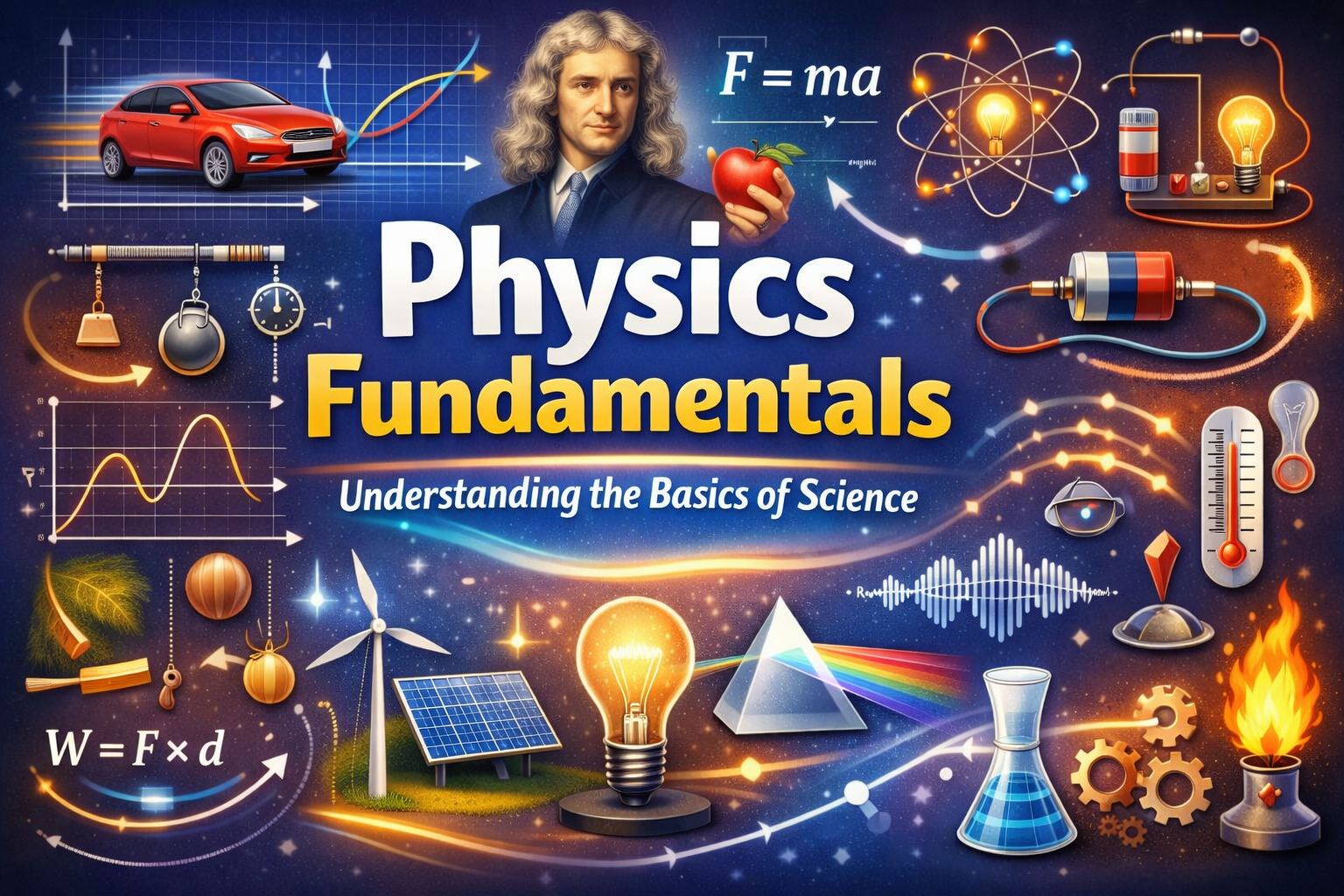
Physics is one of the most important branches of science that helps us understand how the universe works. From the motion of planets to the behavior of tiny particles, everything is governed by physical laws. If you are a student, a science enthusiast, or someone building a learning platform, understanding Physics Fundamentals is the first step toward mastering this subject.
In this article, we will explore the core concepts of Physics Fundamentals in a simple, clear, and engaging way. This guide is designed to be beginner-friendly while still offering valuable insights for advanced learners.
What Are Physics Fundamentals?
Physics Fundamentals refer to the basic principles and concepts that form the foundation of physics. These concepts explain how matter and energy interact and how forces influence motion and behavior in the physical world.
Without a strong understanding of these fundamentals, it becomes difficult to study advanced topics like quantum mechanics, relativity, or astrophysics.
Importance of Physics Fundamentals
Understanding Physics Fundamentals is essential because:
- It builds a strong base for advanced studies
- Helps in solving real-world problems
- Improves logical and analytical thinking
- Plays a key role in engineering, technology, and innovation
- Helps explain everyday phenomena like motion, heat, light, and electricity
Physics is not just a subject—it’s a way of understanding reality.
Core Topics in Physics Fundamentals
1. Motion (Kinematics)
Motion is one of the most basic concepts in physics It describes how objects move from one place to another.
Key concepts include:
- Distance and displacement
- Speed and velocity
- Acceleration
- Time
For example, when a car moves on a road, physics helps us calculate how fast it is going and how long it will take to reach a destination.
2. Laws of Motion
The laws of motion explain how objects behave when forces act on them. These laws were developed by Isaac Newton.
The three laws are:
- An object remains at rest or in motion unless acted upon by a force
- Force equals mass times acceleration
- Every action has an equal and opposite reaction
These laws are fundamental to understanding everything from walking to rocket launches.
3. Force and Energy
Force is a push or pull that can change the motion of an object.
Types of forces include:
- Gravitational force
- Frictional force
- Magnetic force
Energy, on the other hand, is the ability to do work.
Types of energy:
- Kinetic energy (energy of motion)
- Potential energy (stored energy)
The law of conservation of energy states that energy cannot be created or destroyed, only transformed.
4. Work and Power
Work is done when a force moves an object over a distance.
Formula:
Work = Force × Distance
Power is the rate at which work is done.
Example:
A person lifting a heavy object is doing work, and how quickly they do it determines their power.
5. Waves and Sound
Waves transfer energy from one place to another without transferring matter.
Important concepts:
- Frequency
- Wavelength
- Amplitude
Sound is a type of wave that travels through a medium like air.
Applications include:
- Music
- Communication
- Medical imaging
6. Light and Optics
Light is a form of energy that allows us to see.
Key topics:
- Reflection (bouncing of light)
- Refraction (bending of light)
- Lenses and mirrors
Optics is used in:
- Cameras
- Glasses
- Microscopes
7. Electricity and Magnetism
Electricity is the flow of electric charge, while magnetism is related to magnetic fields.
Basic concepts:
- Current
- Voltage
- Resistance
These are essential for understanding circuits and electronic devices.
Electricity powers:
- Homes
- Industries
- Technology
8. Heat and Thermodynamics
Thermodynamics deals with heat and temperature.
Key ideas:
- Heat transfer
- Temperature
- Energy conversion
Heat can transfer in three ways:
- Conduction
- Convection
- Radiation
These principles are used in engines, refrigerators, and climate systems.
Real-Life Applications of Physics Fundamentals
Physics Fundamentals are not just theoretical—they are everywhere in daily life:
- Driving a car involves motion and force
- Cooking uses heat and thermodynamics
- Mobile phones rely on electricity and waves
- Sports involve energy and motion
Understanding these basics helps us make better decisions and appreciate how things work.
How to Learn Physics Fundamentals Effectively
Here are some practical tips:
1. Start with Basics
Focus on understanding concepts instead of memorizing formulas.
2. Use Visual Learning
Diagrams, videos, and animations make learning easier.
3. Practice Regularly
Solve problems daily to strengthen your understanding.
4. Connect with Real Life
Relate concepts to everyday experiences.
5. Revise Frequently
Regular revision helps retain information.
Common Mistakes to Avoid
When learning Physics Fundamentals, avoid:
- Memorizing without understanding
- Ignoring basic concepts
- Skipping practice problems
- Not asking questions
Physics becomes easy when you build a strong foundation.
Why Physics Fundamentals Matter in Modern World
In today’s world, physics plays a key role in:
- Technology development
- Space exploration
- Medical advancements
- Engineering innovations
From smartphones to satellites, everything depends on Physics Fundamentals.
Future Scope of Physics
Physics is constantly evolving. Advanced fields include:
- Quantum physics
- Astrophysics
- Nuclear physics
- Artificial intelligence integration
But all these fields are built on strong Physics Fundamentals.
Conclusion
Physics Fundamentals are the building blocks of understanding the universe. Whether you are a student, teacher, or content creator, mastering these basics opens the door to endless possibilities. physics fundamentals